What does a microbial concern mean for your home?
Bacteria are living microorganisms. Viruses are much smaller infectious agents. Many microorganisms are harmless, but a positive coliform or E. coli test, a boil-water advisory, flooding, a storage-tank problem, or a private-well event means the source and plumbing should be evaluated.
Follow instructions from your local water or health authority during an active advisory. A household product is not a substitute for emergency guidance.
When should you test the water?
Private well water triggers


- Test after a known event. Flooding, repairs, well service, long periods of non-use, or a storage problem can justify retesting.
- Check water clarity. Cloudy water and suspended particles can interfere with UV treatment.
- Use a qualified lab. Storefront content cannot confirm that water is microbiologically safe.
City water triggers

- Follow the utility notice first. Use the testing, flushing, and boiling instructions issued by the local water authority.
- Consider testing after a documented event. A main break, pressure-loss event, or repair may justify testing when the authority or a qualified professional recommends it.
- Investigate persistent changes. Sudden cloudiness or discoloration after a utility event should be reported and evaluated rather than diagnosed from appearance alone.
What does UV do—and what doesn’t it do?
UV-C is used to inactivate susceptible microorganisms as water moves through the chamber. It damages their DNA or RNA so they can no longer reproduce. UV does not physically remove particles from the water.
UV is not a sediment filter, water softener, or chemical-removal system. It does not remove hardness, TDS, salts, chlorine, iron, sulfur, taste, odor, or visible debris.
UV and chlorine
Why UV can add protection beyond chlorination
Chlorine remains important because it can control many microorganisms and leave a disinfectant residual. However, the CDC notes that chlorine may not work as well against resistant parasites such as Cryptosporidium and Giardia. A properly selected UV system adds a physical inactivation barrier as water passes through the chamber.
| Microorganism group | Chlorine context | UV-C role |
|---|---|---|
| Cryptosporidium Parasite—not a bacterium | Highly chlorine-tolerant under typical water-disinfection conditions. | Validated UV-C can inactivate it when the required dose reaches clear water at the rated flow. |
| Giardia Parasite—not a bacterium | Its cyst shell helps protect it from chlorine, so disinfectant type, concentration, contact time, and water conditions matter. | UV is one treatment option for clear water when the system delivers the required dose. |
| Common bacteria Examples: E. coli and coliforms | Many bacteria are susceptible to properly applied chlorination. A positive test still calls for source and plumbing investigation. | Properly delivered UV-C adds an inactivation step, but it does not provide residual protection downstream. |
| Viruses Response varies by virus | Chlorine is effective against many viruses when the correct concentration and contact time are maintained. | Some viruses require higher UV doses than protozoa. Use model-specific validation—not a generic kill percentage. |
Important: This is a technology overview, not a claim that every Glonyx model has been tested against every organism. Actual performance depends on delivered UV dose, peak flow, UVT, turbidity, installation, and maintenance.
Official references: CDC household water treatmentCDC Giardia guidanceEPA LT2 and UV guidance
What treatment steps may be needed?
Remove sand, rust flakes, and other visible material before the UV chamber when those problems are present.
Iron, hardness, turbidity, or other test results may require separate treatment before UV.
Choose the exact model for peak household flow and keep the lamp or LED module, chamber, and quartz surfaces maintained as directed.

Clear water and correct sizing matter
UV performance depends on the flow and water conditions listed for the model, along with proper installation and maintenance. A larger house does not automatically need the largest unit—the real peak flow is what matters.
Model-specific evidence
Use the test report and documentation for the exact model you are considering.
Peak household flow
Size around simultaneous demand, not only average daily use.
Maintenance access
Leave room for inspection and service, and follow the replacement schedule for the exact unit.
Which Glonyx UV setup fits your home?
GX-LED-01 is a compact point-of-use option where its 1 GPM / 4 LPM rating fits the faucet and plumbing setup.
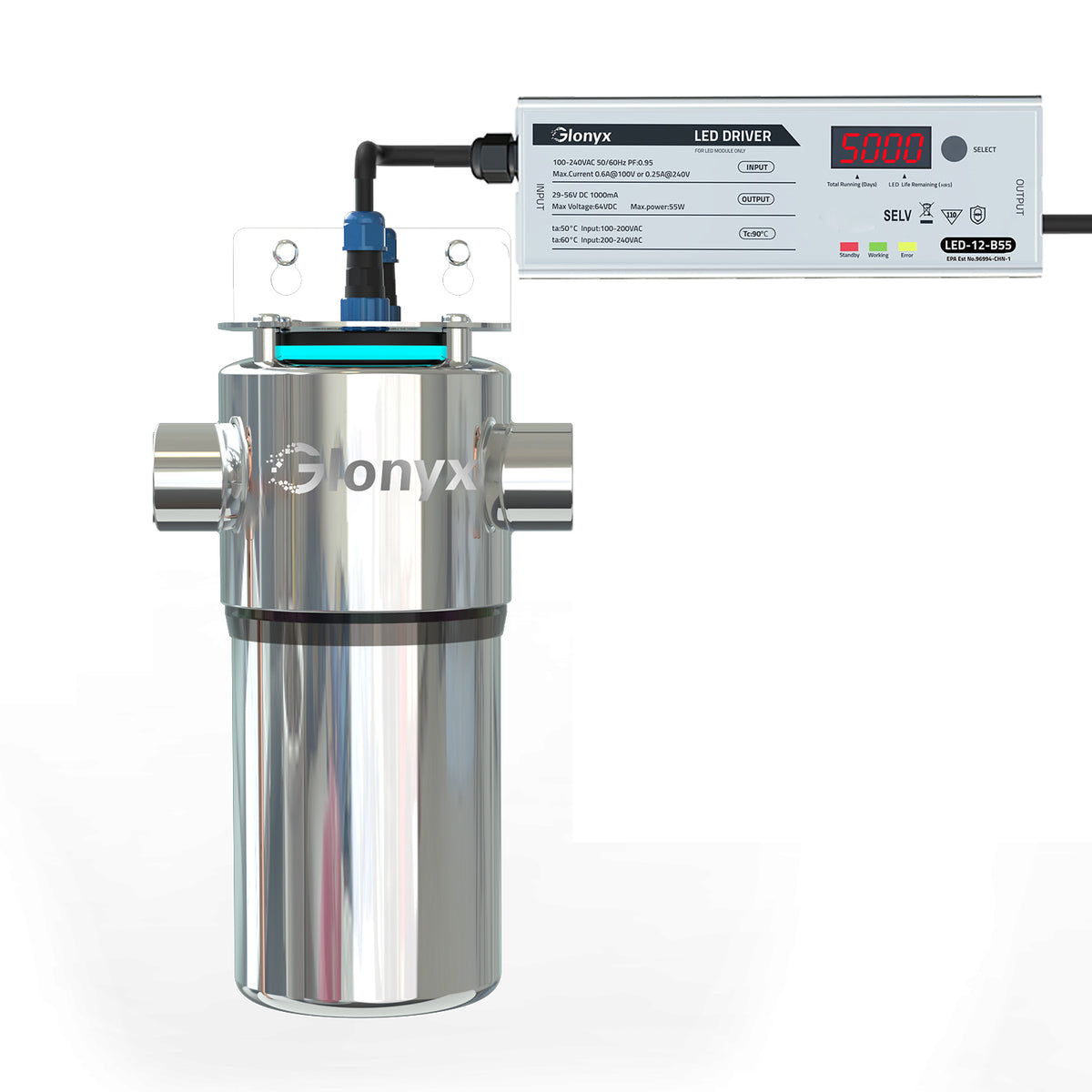
More detailsGX-LED-12 is designed for point-of-entry use at up to 12 GPM under the conditions listed for the model.
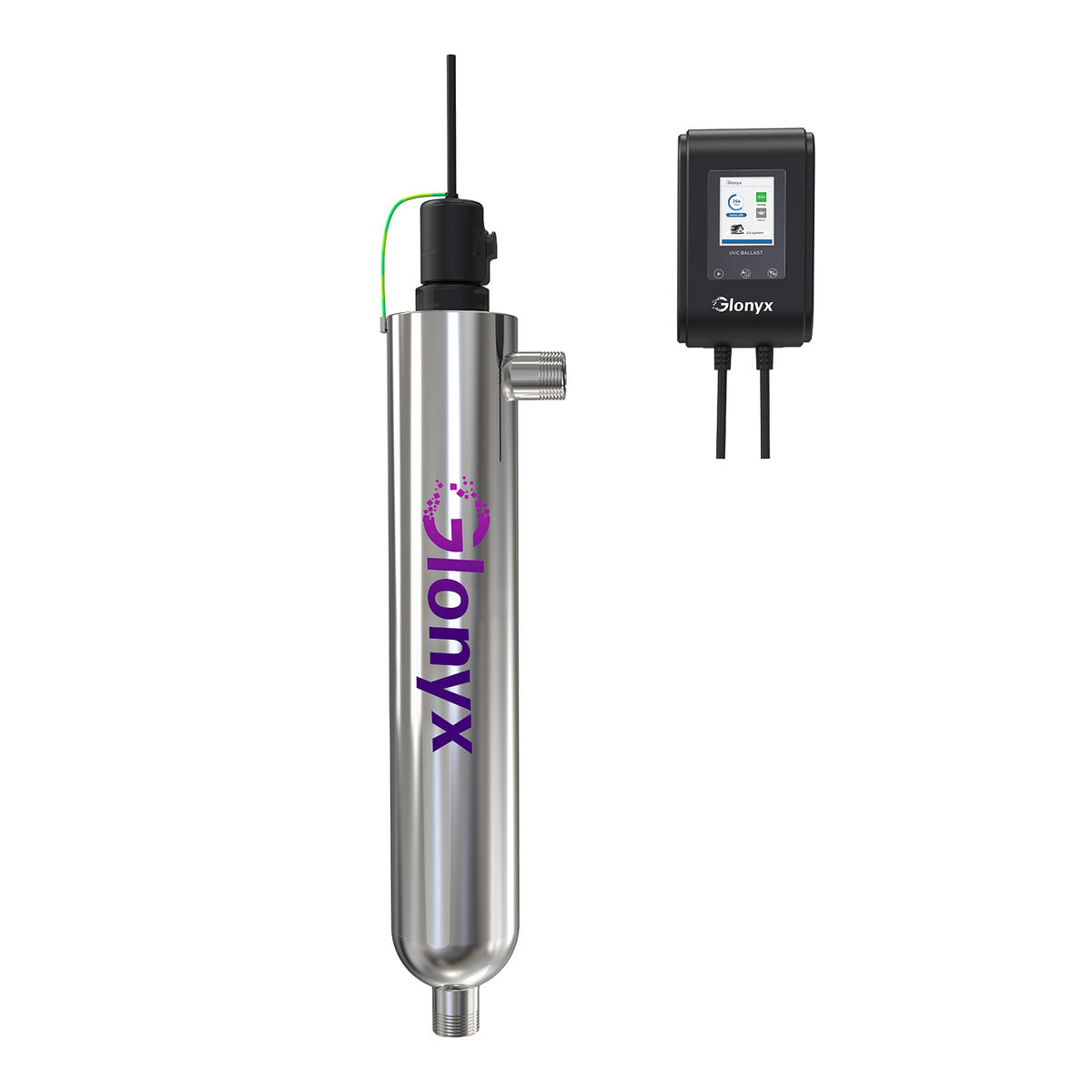
More detailsGX-UV-AE offers 8, 12, and 22 GPM options for homes that prefer a lamp-based platform.
More detailsCheck your setup before ordering
Share your water source, recent test results, peak flow, pipe size, pressure, existing filters, and installation photos. Most whole-home installations should be completed by a qualified plumber or water-treatment professional.
Check My SetupFrequently asked questions
Does UV remove bacteria and viruses from water?
UV is an inactivation step, not a physical filter. Under the flow and water conditions listed for the exact model, UV-C damages susceptible microorganisms so they can no longer reproduce.
Is UV enough for private well water?
Not automatically. Test the well and address sediment, turbidity, iron, hardness, sulfur, pH, nitrate, or other concerns before finalizing the system.
Does boiling water help during an advisory?
Follow the exact boil-water instructions from your local authority. Do not treat a permanent household system as a substitute for an active advisory.
Does UV change taste or odor?
No. Taste and odor concerns require a separate diagnosis and treatment step.
This guide is educational. Microbial safety must be confirmed through appropriate testing and local guidance.